Tuesday, 9 August 2016
and now another three years have passed - unbelievable!
It is certainly hard to believe that it is more than 3 years since my last post. Two reasons for returning at this moment in time. First, a recent article in the New Civil Engineer from a representative of the asphalt industry bemoaned the way in which local authorities are currently wasting money filling in potholes on British roads instead of tackling their route causes - a subject that the most recent blogs was addressing, but more on that later. Second, I find myself enjoying the tranquillity of the Tuscan countryside with more than usual time on my hands to take-up some of the past themes and hopefully add some new ones to the blog. In doing so I will try to respond to any queries on previous postings and add material to some of the postings that were I realise were left unfinished.


Thursday, 23 May 2013
And some further examples of push-pull failure:
The examples of
push-pull motion discussed in the previous blog were the result of differences
in material properties in tension and compression. There are other forms of
push-pull motion (sometimes referred to as pulsatile motion) that result from
some other type of differential material property. For example, many materials
exhibit relatively high rates of visco-plastic creep flow at elevated temperatures
compared with those at low temperatures. If significant differences occur over
the typical temperature ranges experienced by a solid sheet, then again a
gradual outward motion can occur.
Figure 5 shows
evidence of such motions occurring in asphalt sheets covering essentially
horizontal pavement at a location subject to fairly extreme circadian
temperature cycles. That these motions occur is often best seen at the outer
edges of any rigid constraint that impedes motion; at these locations there is
a form of compression pile-up to form ridges. These are often observed to occur
together with adjacent tension induced furrows. Sometimes the ridges take the
form of an accumulating single large ridge and at other times there is a
sequence of many ridge-furrow formations. Each ridge and furrow is generally
the result of accumulations of failure occurring over many alternations in
temperature. Figure 5(a) captures the clear effects of the gradual motions of
the asphalt from right to left around a relatively rigid obstruction in the
path of the outward motion. To describe this process as flow could be
misinterpreted to imply some form of continuous motion, whereas what appears to
take place is a discontinuous motion powered by compression and tension pulses
originating from alternations in temperature. It is for this reason that the
characterisation “thermal pulsatile motion” has sometimes been preferred.
A second clear example of thermal ratchet motion in
asphalt is shown in Figure 6. This depicts a step to a shop in North London which had an asphalt sheet laid over its
surface to prevent leaks into a basement area beneath. The top darker section is
an essentially horizontal tread of the step and the bottom, lighter, section is
the vertical riser. Over a period of years a high proportion of the asphalt
from the horizontal surface has been extruded over the lip to form a
distinctive tongue having clear down-slope convexity. That alternations of
temperature have been powering this motion is again made clear by the bands of
ridges and furrows. On the horizontal surface the directions of the asphalt
motions feeding this overflow, are orthogonal to the bands of ridge-furrow
formations. Comparing this with the ogives in the glacial flow it becomes
possible to envisage a very similar form of thermally powered, pulsatile
motion, driving each of these processes.
(a)
(b)
(c)
Figure 5: Evidence of a push-pull form of asphalt motion
around a relatively rigid concrete
skylight.
Figure 6: A tongue of asphalt extruded from an ostensibly
horizontal step tread.
These forms of pulsatile motion due to the differences in
material properties when hot and cold have been discussed elsewhere (Croll, J.
G. A.,
Proc. Roy. Soc. Xxx)
One last example before I stop boring you with asphalt pavement
failures, is that of Figure 7; this shows an area of
asphalt that is experiencing a rather unusual form of alligator cracking.
Within most of the central zones of the irregular crack polygons, the asphalt
displays an increase in elevation relative to its original position. It is
believed that the process responsible for developing this form of high centred
detritus-crack polygon is similar to that previously suggested to be
responsible for the development of asphalt blisters (blog of March 2010). It will occur
when the compressive stresses developed during the warming phase of the
temperature cycle are great enough
to induce an upward blister buckling. For this to occur the bond between the
(a)
(b)
Figure 7: Areas of detritus-wedge polygons with blister
uplift deformation occurring within many of the polygons.
asphalt sheet and the subgrade
would need to be low and the thickness of the asphalt relatively thin. It is
interesting to observe in Figure 7(b) an area in the background where a field
of incipient blisters is occurring without any evidence of an associated network
of discrete thermal cracks.
Observations of thermal shoving failures in pavements:
Recent blogs have concentrated upon the
cracking failures occurring in asphalt as a result of thermal stresses. But
generally if a change in temperature causes tensile cracking failure then a
temperature change in the opposite sense is likely to induce compression and a
number of associated shoving forms of failure mode. Here are just a few
examples where pavements exhibit signs of compression related shoving failures.
Figure 4(a) shows paving slabs on a
footpath in Camden Town, London. Over a period of time the staggered
longitudinal cracks between adjacent slabs have been widened due to the opening
up of these cracks during cooling, followed by an infill of detritus preventing
the cracks from closing. Having started with a few mm of spacing between adjacent slabs many have a year or so later reached widths of more than 25 mm. Temperature increases have resulted in a gradual
outward motion of the concrete paving slabs. The outward motion of the slabs
would have been even greater were it not for the adjacent asphalt section of
the pavement partially preventing this motion. In Figure 4(b) can be seen a
ridge of asphalt that has been pushed up by the outward expansion forces from
the concrete slabs.
There are
situations where the shear transfers between paving slabs are sufficient to
induce tensile stresses within alternating slabs great enough to cause a
tensile fracture of the slabs. In these cases it is quite common for the
cracking to follow a generally straight rather than staggered path.

(a)

(b)
Figure 4 : Compression related failures as a result of
expansion, (a) outward movement of pavement slabs and associated widening of
inter-slab cracks, and (b) the shoving-up of adjacent asphalt to form an
asphalt ridge.
I am currently writing this blog while waiting a decent
weather window to allow my sailing on the south coats of Italy to continue. In
this part of Calabria there are extremes of temperature. Sadly I do not have a
camera to record some of the effects on the railway station platforms. Many of
the stations have beautifully tiled surfaces - well they were beautiful before
recent increases in temperature forced rows of tiles to pop-up to form rather
unsightly ridges – in much the same way as laminate floors are heaved up by
temperature or moisture changes inducing compression.
Some more observations of thermal cracking of pavements:
Another
source of thermal ratchet induced cracking seems to be inhomogeneity of thermal
properties either within the asphalt mix or with respect to any inclusions
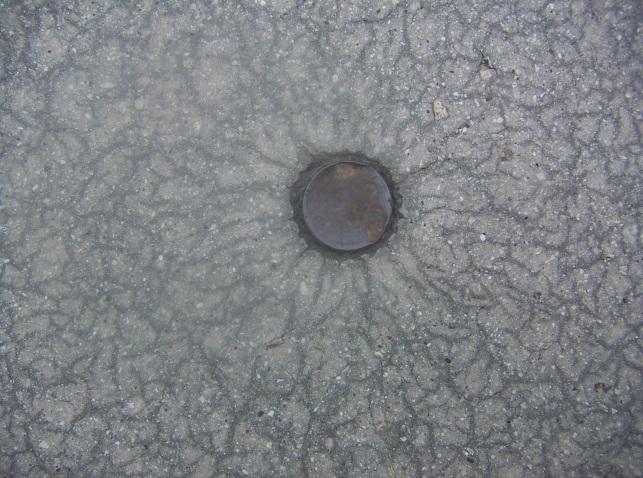
within the asphalt layer. Figure 3a shows a concrete manhole surround that was
originally embedded integrally into an asphalt layer. Figure 3b and 3c show steel
pegs that were driven into an existing asphalt layer. Over a period of years some
intriguing thermal ratchet stress cracking has developed. As a consequence of
the high thermal expansion coefficient of the asphalt, and especially the
bituminous binder, relative to the concrete or steel intrusion, any heating
will result in the holes in the asphalt trying to pull away from the relatively
stiff inclusions. Associated thermal tension stresses normal to these
boundaries have eventually led to cracks between the stiff inclusions and the
asphalt.
The loss of
the thermally induced tension normal to these boundaries means that subsequent
increases in temperature will have no restraining tension normal to the
boundary developed in the asphalt. This release of tension could be thought of
as adding to the original stress state an outward compression stress around the
periphery which will develop large tension stresses parallel to the boundary. Associated
thermal tension stresses parallel to the boundaries have induced the cracks
radiating from the corners of the square inclusion and at regular intervals
around the circular inclusion. As previously discussed, detritus entering these
cracks and those parallel with the boundary will prevent them from fully
closing when the asphalt is cooled. Figure 3(c) shows a variant in which binder
has selectively


(b)
(c)
(d)
Figure 3:
Examples of thermally induced cracks caused by differential thermal expansion
coefficients between asphalt layer and an inclusion consisting of: (a) a
concrete manhole; (b) (c) steel pegs driven into pre-existing asphalt; and (d)
a hole drilled into a pre-existing asphalt layer.
leeched into
the stress cracks to form an intricate pattern within the asphalt. An extreme
example of the effects of this form of thermal inhomogeneity is shown in Figure 3(d); here a hole drilled into the original asphalt layer can be seen to have
induced seemingly disproportionate crack consequences. Although it has not been possible to produce
photographs, the writer has also observed at microscopic levels similar crack
patterns developing around aggregates used in some asphalts. Could the differential
expansion coefficients between the binder and the aggregates be an initiating
factor in many forms of asphalt cracking? And could the ingress of detritus
preventing the closure of these micro-cracks be a factor in their development
and eventual propagation into fully formed thermal ratchet crack patterns?
These are all intriguing questions the answers to which are beyond the scope of
this blog; they would though appear to be worthy of more detailed research.
Some further comments on pavement cracking.
One of the
purposes of the recent blogs has been to suggest that alternations in solar
radiation may be contributing to what is one of the most common forms of
asphalt pavement failure – alligator cracking. It has been argued that certain
forms of asphalt become relatively brittle at low temperatures, and especially
where age, strain or work hardening has been experienced, or moisture related
leaching or solar embrittlement, have occurred. During the cooling phase
restrained contraction will induce tension stresses which can often cause
cracking. Due to ingress of detritus, cracks may not be closed during the
subsequent heating phase. Over many repetitive cycles the cracks are observed
to open up and propagate to eventually form well defined alligator crack
patterns, in a process that could be regarded as thermal ratchetting. This
process would appear to be responsible for crack patterns other than alligator
cracking. Furthermore, low temperature embrittlement would seem to be not the
only cause of thermal ratchet induced cracking.
Spatial
inhomogeneity in levels of solar radiation experienced by the asphalt can often
result in differential thermal stresses that sometimes induce cracking. This
can be caused by the use of light coloured road markings that reflect a greater
proportion of the incoming radiation than the adjacent black surfaced asphalt,
often resulting in wide cracks adjacent to the edges of the road markings. An
example taken from my cycle route into work allowed long term observations on
the growth of such crack formations. A section of this cracking is shown in Figure
1. While the yellow lines have started to fade, the differences in solar
reflection over time have meant that the areas beneath the road marking experienced different
thermal conditions to the rest of the road surface. On very cold days these
cracks could be as wide as 10mm. Eventually the cracks started to affect the
integrity of the road surface and a new one was laid.
Figure 1:
cracking along edge of road marking caused by differential solar reflection.
During a
lively discussion following presentation at in International Conference of
results like those discussed above, and also in some previous blogs, my
attention was drawn to another way in which non-homogenous insolation can cause
pavement cracking. If some insulating material is laid upon an asphalt surface
it can change the temperatures beneath the insulation compared with that of the
adjacent road surface. This too can cause differential stresses that may result
in cracking. Figure 2, shows a fascinating example of cracks due to this cause.
Over a period of weeks a pad of fairly well indurated horse manure was observed
in a quiet lane in Devon to eventually result in cracks developing around the
periphery of the horse pad (this is a polite description of a pile of horse
dung). In this case the horse pad has provided a localised difference in the
level of heating and cooling induced in the asphalt. It is apparent that the
cracks again preferentially form at the boundaries between the aggregate stones
and the bituminous binder.
Figure 2:
Development of peripheral cracking around a pad of horse manure caused by
differential insulation to heating of the asphalt. [Photo courtesy of Dr E A W
Maunder]
And now another year has passed – quite unbelievable!
Having been on a bit of a role in
relation to ice, detritus and sand wedge polygons last February, a number of
events conspired to take my mind from matters related to this blog. The first
occurred at the end of February last year when “I Beatrice” an earlier
contributor to this blog died fairly suddenly. While I would of course have
been saddened by such an event it would normally not have thrown me off course quite
so much. But this blogger was very special - for
“I Beatrice” was my dear sister Gillian and the last remaining member of the
nuclear family within which I grew up in New Zealand. As I write more than 12
months later a persistent lump still comes to the throat.
The second reason why my attention had
been so diverted, relates to another little project I have been working on for
the past few years and which now seems to be coming to some sort of fruition.
As a student I spent one of my summer breaks working as a labourer at the
Benmore, Hydroelectricity project being developed near the remote and rather
unremarkable little town of Otematata, at the centre of the South Island of New
Zealand. Civil Engineering students in NZ were in the middle decades of the 20th
C often supported by bursaries provided by the Ministry of Works. In exchange
for maintenance during our studies we were expected to work for the MoW in each
of our vacations and for at least a 3 year period following graduation. My Otematata
work training period was officially defined as working as a labourer to ensure
that future engineers understood a little of what it was like to be grinding
the concrete of walls where shuttering had been deficient, laying hot steel
bars into fiendishly complex reinforcing schedules for floor slabs, laying post-stressing cables in penstocks, … Part of
this particular training at Benmore was spent working within a scaffold gang
constructing massive scaffold structures within what would eventually become
the spillway gates. Looking back I cringe at the risks being taken with at the
time H&S taking a pretty low priority. But having survived you may well be
asking what on earth this has to do 50 years later with my neglect of a blog
dealing with phenomena such as pingos, asphalt blisters, … Well curiously it
has.
For the reason for my distraction has
been to develop a new form of scaffold structure based not upon the use of
heavy and normally rusty old steel tubes and couplers but upon lightweight and
non-corrosive composite tubes and couplers. The last year has been particularly
challenging for this project not least because one of the companies responsible
for the maintenance of the offshore structures providing oil and gas from the N
sea, have been trialling these new products in anticipation of replacing their
current reliance upon steel products with those based upon our new composite
ones. But perhaps I might provide more on all this in a later blog.
Tuesday, 21 February 2012
References cited in the asphalt cracking posts
AAT Report, Report to NCHRP Proj 1-42: Top-down Fatique Cracking of Hot-mix Asphalt Layers, May, 2004, pp105.
Bunge, A. A. Naturhistorische beobachtungen und fahrten im Lena-delta, Akad. Imp. Sci. St Petersbourg Bull, 3rd series, 29, 1884, 422-476.
Croll, J. G. A. From asphalt to the Arctic: New insights into thermo-mechanical ratchetting processes, IIIrd Euro Conf on Computational Mechanics, Lisbon, Portugal, 5-8 June, 2006.
Croll, J. G. A. A new hypothesis for for the development of blisters in asphalt pavements, Int J Pavement Engineering, 2007.
Hoque, Z. Chpt 19, in Handbook of Highway Engineering, Taylor Francis Publ., Twa, T. F. (Ed), 2006.
Lachenbruch, A. H. Mechanics of thermal contraction cracks and ice-wedge polygons in permafrost, Geol. Soc. America Spec Paper, 70, 1962, pp69.
Leffingwell, E. de K. Ground-ice wedges, the dominant form of ground-ice on the north coast of Alaska, J of Geology, 23, 1915, 635-654.
Lytton, R L, Uzan, J, Fernando, E G, Roque, R, Hiltunen, D, Stoffels, S. Development and validation of performance prediction models and specifications for asphalt binders and paving mixtures, Report SHRP-A-357, Washington DC, National Research Council, 1963.
Mackay, J. R. Ice-wedge cracks, Garry Island, NWT. Canadian J. Earth Sci., 11, 1974, 1366-1383.
Mackay, J. R. Thermally induced movements in ice-wedge polygons, western Arctic coast: A long term study. Geographie physique et Quarternaire, 54, 2000, 41-68.
MATES, (1988) Michigan Department of Transportation, Flexible pavement distress – part 1, 21, July, 1988.
Matsuna, S and Nishizawa, T. Mechanism of longitudinal surface cracking in asphalt pavements, Proc. 7th Int Conf on Asphalt Pavements, Vol. 2, Nottingham, UK, 1992, 277-291.
Myers, L. R., Roque, R. and Ruth, B. E. Mechanisms of surface initiated longitudinal wheel path cracks in high bituminous pavements, J Association of Asphalt Paving Technologists, 67, 1998, 401-428.
NCHRP, National Cooperative Highways Research Program, Project 1-42, Models for predicting top-down cracking of hot mix asphalt layers, 2004.
Shell, Bitumen Handbook, Thomas Telford Publ., 2003.
Hoque, Z. Chpt 19, appearing in Handbook of Highway Engineering, Taylor Francis Publ., Twa, T. F. (Ed), 2006.
Wamburga, J. H. G., Maina, J. N. and Smith, H. R. Kenya asphaltic materials study, submitted to the Transport Research Board 78th Annual Meeting, Jan., Washington DC, 1999.
Washburn, A. L. Geocryology: A survey of periglacial processes and environments, second edition, Edward Arnold Ltd, London, 1979.
Bunge, A. A. Naturhistorische beobachtungen und fahrten im Lena-delta, Akad. Imp. Sci. St Petersbourg Bull, 3rd series, 29, 1884, 422-476.
Croll, J. G. A. From asphalt to the Arctic: New insights into thermo-mechanical ratchetting processes, IIIrd Euro Conf on Computational Mechanics, Lisbon, Portugal, 5-8 June, 2006.
Croll, J. G. A. A new hypothesis for for the development of blisters in asphalt pavements, Int J Pavement Engineering, 2007.
Hoque, Z. Chpt 19, in Handbook of Highway Engineering, Taylor Francis Publ., Twa, T. F. (Ed), 2006.
Lachenbruch, A. H. Mechanics of thermal contraction cracks and ice-wedge polygons in permafrost, Geol. Soc. America Spec Paper, 70, 1962, pp69.
Leffingwell, E. de K. Ground-ice wedges, the dominant form of ground-ice on the north coast of Alaska, J of Geology, 23, 1915, 635-654.
Lytton, R L, Uzan, J, Fernando, E G, Roque, R, Hiltunen, D, Stoffels, S. Development and validation of performance prediction models and specifications for asphalt binders and paving mixtures, Report SHRP-A-357, Washington DC, National Research Council, 1963.
Mackay, J. R. Ice-wedge cracks, Garry Island, NWT. Canadian J. Earth Sci., 11, 1974, 1366-1383.
Mackay, J. R. Thermally induced movements in ice-wedge polygons, western Arctic coast: A long term study. Geographie physique et Quarternaire, 54, 2000, 41-68.
MATES, (1988) Michigan Department of Transportation, Flexible pavement distress – part 1, 21, July, 1988.
Matsuna, S and Nishizawa, T. Mechanism of longitudinal surface cracking in asphalt pavements, Proc. 7th Int Conf on Asphalt Pavements, Vol. 2, Nottingham, UK, 1992, 277-291.
Myers, L. R., Roque, R. and Ruth, B. E. Mechanisms of surface initiated longitudinal wheel path cracks in high bituminous pavements, J Association of Asphalt Paving Technologists, 67, 1998, 401-428.
NCHRP, National Cooperative Highways Research Program, Project 1-42, Models for predicting top-down cracking of hot mix asphalt layers, 2004.
Shell, Bitumen Handbook, Thomas Telford Publ., 2003.
Hoque, Z. Chpt 19, appearing in Handbook of Highway Engineering, Taylor Francis Publ., Twa, T. F. (Ed), 2006.
Wamburga, J. H. G., Maina, J. N. and Smith, H. R. Kenya asphaltic materials study, submitted to the Transport Research Board 78th Annual Meeting, Jan., Washington DC, 1999.
Washburn, A. L. Geocryology: A survey of periglacial processes and environments, second edition, Edward Arnold Ltd, London, 1979.
Subscribe to:
Posts (Atom)
